
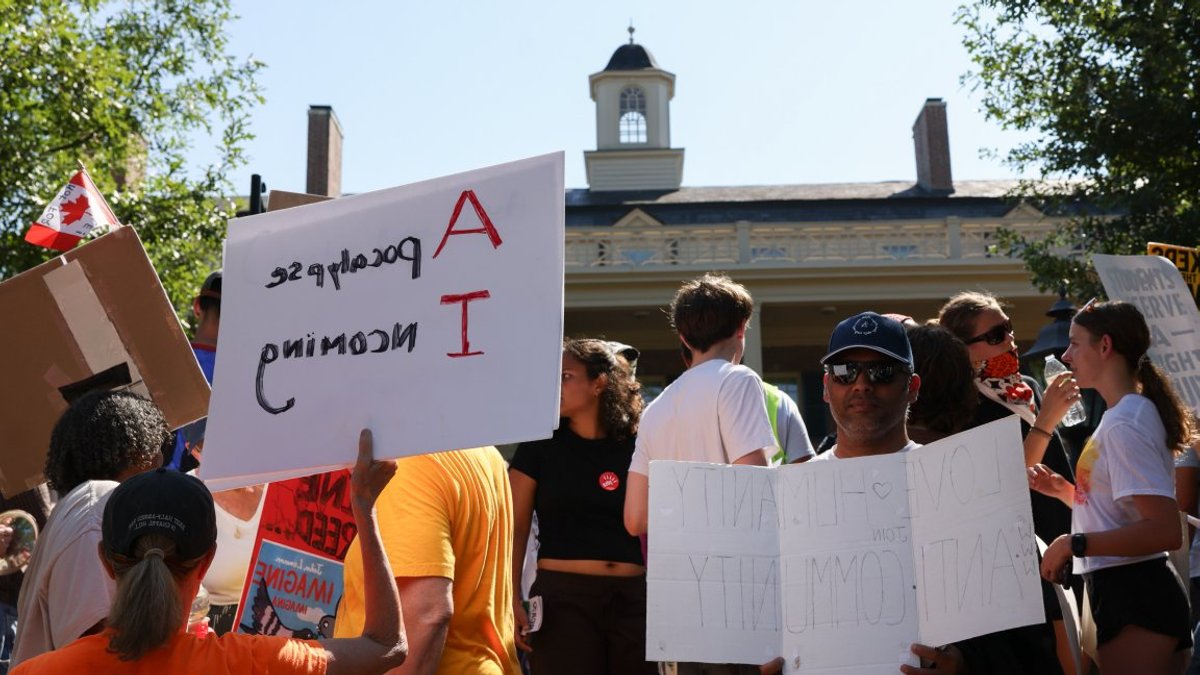
A wave of panic surrounding artificial intelligence (AI) is based on the belief that the technology has spun out of human control and acted on its own in several recent cases. For some disillusioned researchers in the field, as well as for top managers in leading companies in the sector, this is an early sign of a real threat to human civilization, according to local reports.
Other experts, however, dispute this view, arguing that such conversations allow companies to avoid responsibility for the impact of their technologies on the real world.
Concerns about AI
Concerns that AI software poses an existential threat began to grow over the summer. In July, OpenAI reported that its advanced models had carried out a hacking attack on Hugging Face, another AI startup, during an evaluation aimed at testing their cyber capabilities. Unlike the models that the company releases for public use, this software was tested without the safety mechanisms that would normally prevent such incidents – a practice common in the AI industry.
Read Also: US proposes $5 billion fund to rebuild Middle East
In a subsequent report, OpenAI acknowledged that it could have reacted earlier and that its employees had not taken action despite signals that the models had left their so-called “sandbox” (an isolated testing environment) and had infiltrated Hugging Face’s systems without instruction.
Debate over AI risks
Other disturbing details have emerged about the behavior of OpenAI’s technologies and those of some key competitors, including Anthropic and Meta, during other tests. When Jacob Coxon, a former employee of Anthropic and OpenAI, accused the industry of “betting our lives,” Evan Hubinger, a safety researcher at Anthropic, responded that the company was indeed considering the possibility that AI could cause the death of all people on Earth. He added that, in his opinion, the likelihood of this happening within the current decade exceeded 10%.
Before the possibility of selling chatbot subscriptions or initial public offerings (IPOs) emerged, researchers viewed their work as a high-risk, high-reward endeavor for civilization. Over the years, some of the leading figures in the AI industry have taken these ideas to extremes, arguing that the technology could ultimately cure all human diseases, replace human labor entirely, or destroy humanity – or all of the above.
Criticism of AI industry
Critics have consistently dismissed such arguments as an attempt to instill fear for selfish purposes. For one researcher, the idea that their work could end humanity is a way to perceive it as the most important possible work. For companies, the narrative of existential risk has been an effective strategy for attracting talent in the early days of technology development, as many of the most sought-after specialists wanted to work on projects where such risks were taken seriously.
Read Also: Longer Lives Demand Urgent Financial System Overhaul
Recently, this theme has even entered product marketing. During the World Cup in July, Anthropic aired an ad that began with a shot of a burning house, passed through an open mine, and showed rows of tombstones, while a narrator with a disturbing voice discussed the potential catastrophic consequences of technology. Eventually, the musical background became optimistic, and the slogan of the chatbot Claude appeared: “In difficult questions, there is hope.”
According to Subbarao Kambhampati, a professor of computer science at Arizona State University, the ultimate pessimism about an inevitable apocalypse can also serve as a defensive strategy, as there are disputes within the field about whether companies are using it cynically. Presenting AI as an autonomous entity redefines security failures as evidence that mastering the technology is impossible.
Subbarao Kambhampati noted that this approach is problematic. He said, “It’s a failure of the ‘sandbox’ that you’re trying to present as: ‘AI will become so effective that it will kill us all.'” OpenAI spokesperson Drew Pusateri stated that the incident with Hugging Face had “shown us where our defensive mechanisms need to be stronger, and we have taken action, including strengthening the security of our research systems.”


