
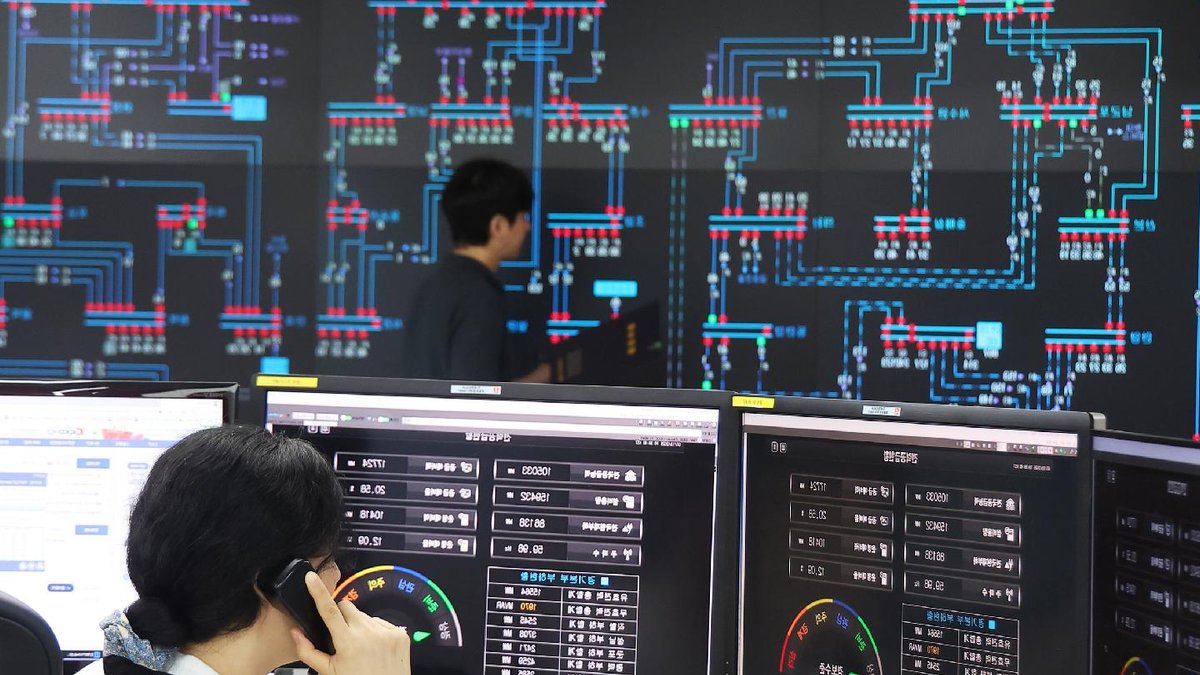
South Korea is racing to build data centers to meet surging artificial intelligence demand, but the push is running into stiff local opposition over power supply worries, electromagnetic waves, and noise pollution. Experts say stable electricity is the most basic requirement for reliable AI infrastructure, and they’re calling for a split approach: short- and medium-term fixes alongside long-term planning.
Summer cooling loads are driving a peak power problem.
Managing peak electricity demand during summer months is a key short-term challenge. These facilities consume significantly more power in hot weather because of cooling loads.
“Electricity consumption at major data centers in Korea shows clear seasonality due to cooling loads in the summer,” said Kim Cheol-hyeon, a senior research fellow at the Korea Energy Economics Institute (KEEI).
Bottlenecks in the power grid are compounding the problem.
Related: LG secures Nvidia certification for AI data center cooling
According to KEEI, 60.4 percent of Korea’s 165 data centers were located in the Seoul metropolitan area as of 2024. Among privately operated facilities, the concentration in the capital region hit 75.3 percent.
The institute pointed out that the real issue isn’t a shortage of power generation capacity itself, but an insufficient number of transmission lines capable of delivering electricity to the Seoul area.
Efforts to expand the network remain stalled.
Korea Electric Power Corp. (KEPCO) reported that 20 of 54 transmission network construction projects included in the government’s 11th Basic Plan for Long-Term Electricity Supply and Demand are behind schedule.
Delays stem from resident opposition and slow permits.
Related: Pharmacy, Health & Wellness: A Comprehensive Approach to Healthcare
The Shin Pyeongchang substation in Gangwon Province, originally slated for completion in 2016, has been pushed back to 2028 — a 12-year delay. The East Coast-to-Eastern Seoul high-voltage direct current (HVDC) project has slipped from 2019 to 2027.
Government targets far outstrip current projections
Over the long term, securing enough overall power capacity is expected to become increasingly critical.
KEEI projected that the total power intake capacity of domestic facilities will rise to 6.9 gigawatts (GW) by 2040, with data center electricity consumption accounting for 4 to 5 percent of the country’s total power use in 2038.
But the government has set a far more aggressive target.
Through the Three Mega Projects for Korea’s Great Leap Forward announced last month, it aims to build AI data centers with a combined capacity of 18.4 GW by 2035 — about 2.7 times the 6.9 GW KEEI projects for 2040.
Related: Drivers Face Varying Speed Awareness Course Fees
The institute recommended establishing a long-term power supply system centered on carbon-free energy sources.
Its analysis, based on the 11th Basic Plan, found that surplus carbon-free generation capacity in 2038 will be concentrated in the Honam region (47.1 GW) and the Yeongnam region (19.7 GW), while the Seoul metropolitan and Chungcheong regions will have relatively limited capacity.
It said a realistic alternative would be to build power supply infrastructure for these sites centered on renewable energy and battery energy storage systems (BESS) in Honam, and on nuclear power and renewable energy in Yeongnam.
The government is also introducing measures to address these problems. In the short and medium term, it plans to increase the capacity of existing transmission lines in the Seoul metropolitan area and expand the power grid through underground transmission lines in densely populated areas.


